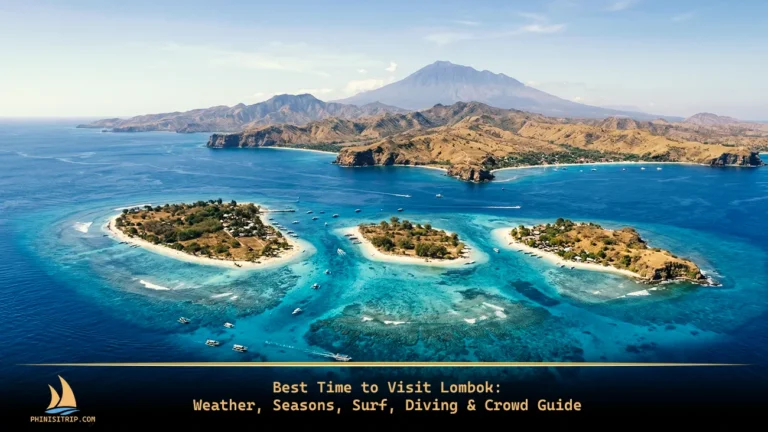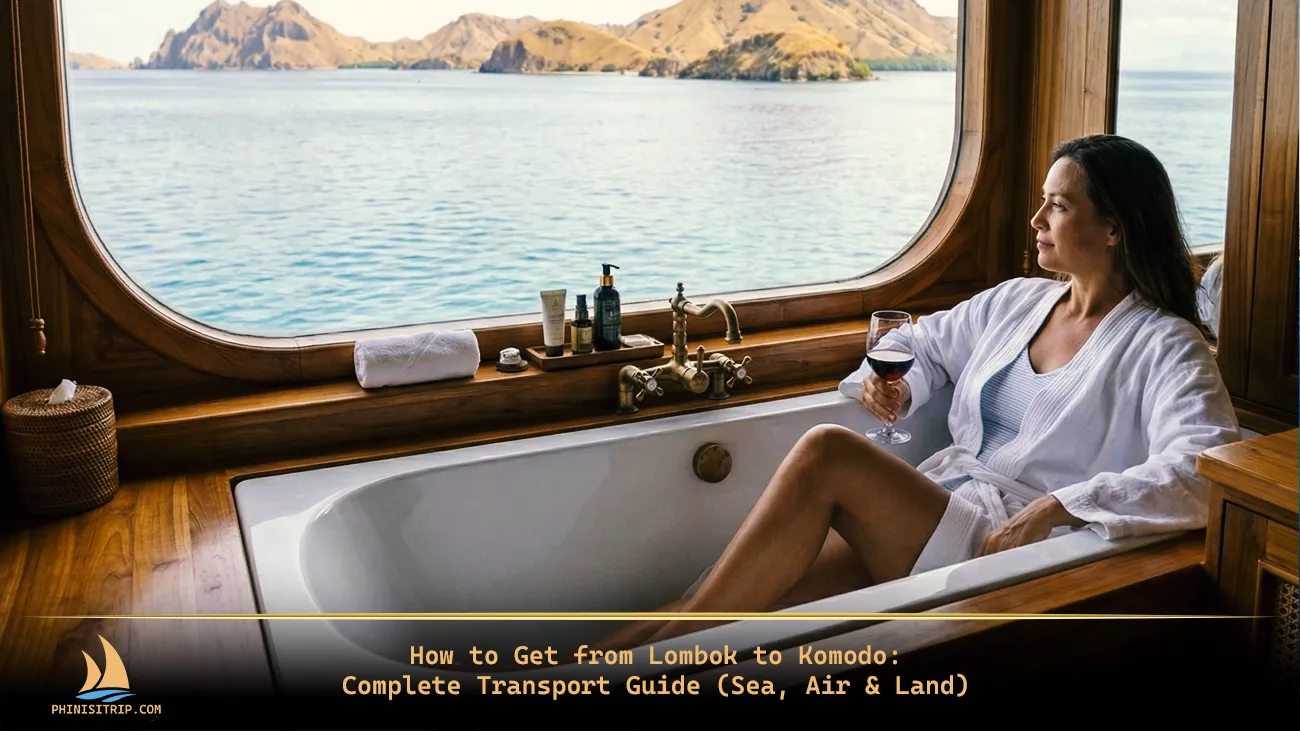
Travelling from Lombok to Komodo requires crossing one of the most geographically complex corridors in Southeast Asia — a chain of islands, straits, and open ocean that stretches across the Lesser Sunda Islands of eastern Indonesia. There is no single direct road, no single ferry terminal, and no airport on Komodo Island itself. Understanding this geography before you plan is not optional; it determines every decision that follows.
Lombok is an island in West Nusa Tenggara province, located immediately east of Bali. It is served by Lombok International Airport (LOP) and is well connected to the rest of Indonesia by both air and sea. Komodo National Park is a UNESCO World Heritage Site established in 1991, comprising Komodo Island, Rinca Island, Padar Island, and surrounding smaller islets in the Flores Sea. It is home to the Komodo dragon (Varanus komodoensis), the world’s largest living lizard, and to some of the most biodiverse marine environments in the Indo-Pacific. The park lies to the west of Flores Island, a long volcanic island in East Nusa Tenggara province. Labuan Bajo is a port town situated on the western tip of Flores Island. It is the sole functional gateway to Komodo National Park — the only point with a commercial airport, regular boat services into the park, and established tourism infrastructure. All practical routes from Lombok to Komodo converge on Labuan Bajo, either as an intermediate stop or as the final land-based anchor before entering the park by sea.
The straight-line distance between western Lombok and Komodo Island is approximately 460 kilometres. The real-world travel distance varies significantly depending on the route taken.
At-a-Glance Summary
- Fastest option: Fly from Lombok International Airport (LOP) to Komodo Airport / Labuan Bajo (LBJ) via Bali — total travel time of 5 to 7 hours, door to door.
- Most immersive option: Liveaboard boat departing northwest Lombok, sailing directly into Komodo National Park over 3 to 5 nights — no airports, no town; the journey is the experience.
- Cheapest option: Overland and public ferry via Sumbawa and Sape — roughly 24 to 40 hours of continuous travel; cost savings over flying are real but modest.
Overview: Distance, Routes & Entry Points
There are only three realistic ways to travel from Lombok to Komodo: by air with a Bali connection, by liveaboard vessel across the Flores Sea, or by a multi-stage overland and ferry route through Sumbawa. Every other option — chartered speedboats, private aircraft, alternative ferry configurations — either does not operate as a regular service or involves cost and logistics far beyond what a standard traveller would consider.
The geography of this journey follows a strict east-west corridor across the Lesser Sunda Islands. Lombok sits at the western end; Flores and the national park at the eastern end. Between them lie the Alas Strait, the island of Sumbawa, the Sape Strait, and finally the Flores Sea approaches to the park. Each transport option navigates this corridor differently — some skipping large sections entirely (the plane), some traversing it slowly and deliberately (the ferry route), and one making the open-water crossing into the park the central purpose of the trip (the liveaboard).
There is no airport on Komodo Island and no scheduled ferry service that terminates there. Labuan Bajo is the mandatory gateway for travellers arriving by air or ferry. For liveaboard passengers, Labuan Bajo is typically the conclusion of the trip, reached after several nights already spent inside the park.
A secondary embarkation point relevant only to the overland route is Sape, a port town on the eastern tip of Sumbawa, from which the government ferry departs for Labuan Bajo across the Sape Strait.
Option 1: Lombok to Komodo by Boat (Liveaboard Experience)
How It Works
The liveaboard is the only option that takes you from Lombok directly into the waters of Komodo National Park without a Labuan Bajo layover. Vessels depart from harbours on Lombok’s northwest coast — most commonly Bangsal or the nearby Teluk Nare — and sometimes from the Gili Islands. They sail east across the open Flores Sea, entering the national park from the western side.
These trips are operated on traditional Indonesian phinisi schooners and modern motor-sailers. They function as all-in-one transport and accommodation packages, combining open-ocean sailing with guided island treks, snorkelling, and diving within the park. Standard itineraries run three to five nights; extended dive-focused itineraries can last seven to ten days. Most conclude in Labuan Bajo on the final morning, allowing passengers to fly home or continue on Flores.
The boats are operated by private dive and sailing companies. Quality varies considerably across the spectrum. Reputable operators maintain certified dive staff, functioning safety equipment, and experienced skippers with documented knowledge of park regulations.
Typical Duration
The distance from northwest Lombok to the first entry points of Komodo National Park is approximately 200 nautical miles. Under motor-sail, this takes 18 to 24 hours of continuous travel. Experienced operators schedule this crossing overnight — passengers sleep through the open-water stretch and wake at the park’s outer islands near dawn. A four-night itinerary typically provides two to three full days inside the park before the final run into Labuan Bajo.
Pros
- Direct access to the national park with no intermediate airport or town stop
- All-inclusive pricing covers accommodation, meals, park entry fees, and guided activities
- Dive sites including Crystal Rock, Manta Point, and Batu Bolong are only fully accessible from a vessel; day-trip boats from Labuan Bajo reach most sites but face time and depth constraints
- Itineraries are timed for sunrise on Padar Island before day-trip crowds arrive
- Eliminates the need to book separate Labuan Bajo accommodation
Cons
- The open Flores Sea crossing is real ocean, not sheltered water; swells of one to two metres are normal and above three metres are possible in wet season; seasickness is a genuine risk that should not be minimised
- Premium-tier boats during peak season (July–September) book out months in advance; last-minute availability at reputable operators is limited
- Once aboard, the itinerary is largely fixed; travellers who want to spend extra time in Labuan Bajo or specific areas of Flores cannot easily adjust
- Budget-tier operators exist at price points that reflect compromises in vessel maintenance, safety equipment, and guide quality
- Weather-forced itinerary changes occur; the Flores Sea between November and March is the most variable period
Option 2: Lombok to Komodo by Plane (Via Labuan Bajo)
Route Explanation
Flying is the fastest and most logistically straightforward route from Lombok to the Komodo gateway. The air route operates as follows:
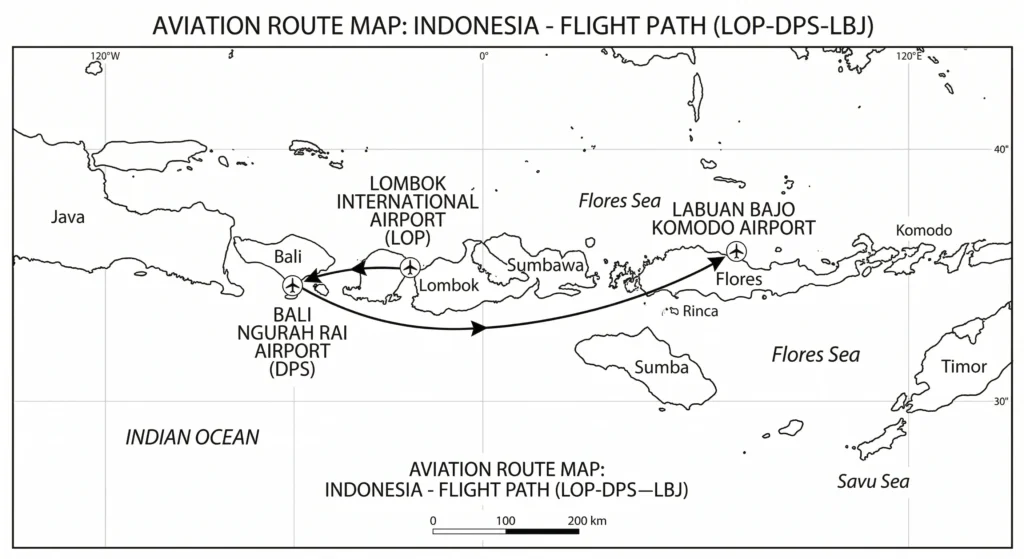
Lombok International Airport (LOP) → Ngurah Rai International Airport, Bali (DPS) → Komodo Airport, Labuan Bajo (LBJ)
As of recent travel seasons, there are no direct scheduled flights between Lombok and Labuan Bajo. All commercial connections require a transit through Bali. The Bali–Labuan Bajo leg is predominantly operated by Wings Air on ATR-72 turboprop aircraft, a standard choice given Komodo Airport’s runway specifications. Garuda Indonesia, Lion Air, and Citilink also service the route with varying frequency depending on season.
From Komodo Airport, Labuan Bajo town is approximately ten minutes by vehicle. The main harbour, where day trips and chartered boats into the national park depart, is within easy walking distance of most accommodation. Day trips into the park can typically be arranged on short notice through guesthouses, hotels, or directly at the harbour — though booking the morning prior is advisable during peak months.
Travel Time
A same-day connection through Bali — which is the standard routing — puts total air travel time at approximately two to three hours of flight across both legs, with a connection gap of one to two hours at Ngurah Rai. Door-to-door travel time from Lombok to Labuan Bajo, including airport transfers and check-in, runs five to seven hours under typical conditions.
Late-day departures from Lombok may necessitate an overnight in Bali before the morning Wings Air departure to Labuan Bajo; in this case, the journey spans two days. Planning the outbound Lombok flight for morning departure avoids this complication.
Who This Option Is Best For
Flying is the correct choice for the following traveller profiles:
- Travellers on itineraries of one to two weeks covering multiple Indonesian destinations, for whom 24 to 40 hours of overland travel is not a viable time investment
- Those whose primary interest is Komodo’s terrestrial experience — dragon trekking on Komodo or Rinca Island, hiking Padar, and snorkelling — rather than multi-day diving
- Travellers with any meaningful susceptibility to sea sickness, for whom the open Flores Sea crossing on a liveaboard presents a significant physical risk
- Families with children or mixed-ability travel groups, for whom the physical demands of the overland route are not practical
- Travellers visiting during the wet season (November–March), when sea conditions make the liveaboard option significantly less comfortable and scheduling less reliable
Option 3: Lombok to Komodo by Ferry & Land (The Overland Route)
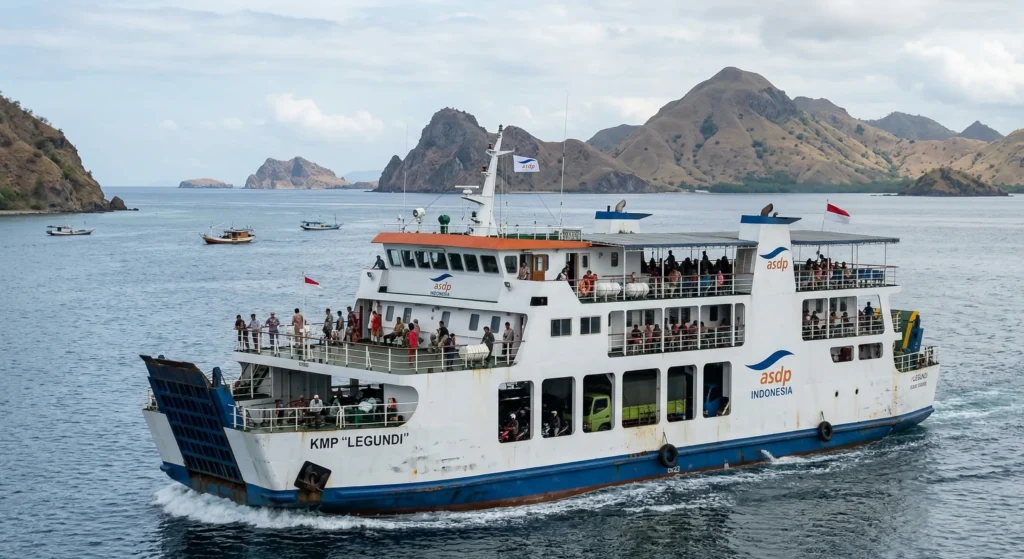
Step-by-Step Overview
The overland-and-ferry route is the traditional method for crossing the Nusa Tenggara island chain before reliable air connections existed. It remains viable and is used by budget travellers, overlanders, and those who find meaning in ground-level travel across the archipelago. It is not recommended for travellers on a schedule.
Step 1 — Lombok to Sumbawa by ASDP Ferry Depart from Lembar Port on Lombok’s southwest coast. The government-operated ASDP ferry crosses to Poto Tano on the western coast of Sumbawa. This crossing takes approximately two hours and departs frequently around the clock — multiple sailings daily mean this leg rarely creates a bottleneck.
Step 2 — Poto Tano to Sape by Bus From the Poto Tano ferry terminal, public buses and shared minibuses (bemo) travel east across the full length of Sumbawa to the port town of Sape. This road journey covers roughly 300 kilometres of variable terrain and takes between seven and ten hours. The highway through central Sumbawa is serviceable but uneven in quality; expect dust, heat, and stops at small towns along the route.
Step 3 — Sape to Labuan Bajo by ASDP Ferry From Pelabuhan Sape, the government ferry crosses the Sape Strait to Labuan Bajo. The crossing takes approximately eight hours and has historically operated on a schedule of several departures per week — not daily. As of recent travel seasons, departures typically run in the late afternoon or evening, arriving in Labuan Bajo by early morning. This schedule is subject to seasonal changes and weather suspensions. Confirm the current timetable locally before planning around it.
Step 4 — Labuan Bajo to Komodo National Park As with the air option, proceed from Labuan Bajo port by day trip or chartered boat.
Realistic Travel Duration
Under ideal conditions — prompt connections, no missed ferries, a reliable bus — this journey can be completed in approximately 24 hours. In practice, it regularly extends to 30 to 40 hours due to connection gaps, ferry scheduling, and the variable pace of Sumbawa road travel. Budget for at least two full days of travel if attempting this route.
Clear Warnings and Downsides
Ferry schedules are not fixed year-round. The Sape–Labuan Bajo crossing operates on government schedules that change seasonally and are suspended in adverse weather. Travellers who have committed to downstream plans — onward flights from Labuan Bajo, booked accommodation with check-in deadlines — carry genuine risk of disruption on this leg.
The Sumbawa bus crossing is fatiguing in ways that accumulate. Seven to ten hours on an Indonesian intercity bus, following a two-hour ferry and potentially preceding an eight-hour overnight ferry, compounds into significant physical exhaustion. This is not a trivial consideration if you intend to hike Padar Island or trek Komodo Island within 24 hours of arriving.
The cost saving over flying is narrower than it appears. As of recent travel seasons, budget domestic flights between Lombok and Labuan Bajo (via Bali) can be found for USD 60 to 120 per person with adequate advance planning. The full overland route costs USD 25 to 60 per person in transport fares alone — a saving of USD 30 to 100 that does not account for meals en route, any accommodation needed mid-journey, or the real-world value of 24 to 40 hours of travel time versus five to seven hours.
There are no tourist attractions along the Sumbawa corridor. Unlike the liveaboard, this route offers no compensatory experience for the time spent. It is transit, not travel.
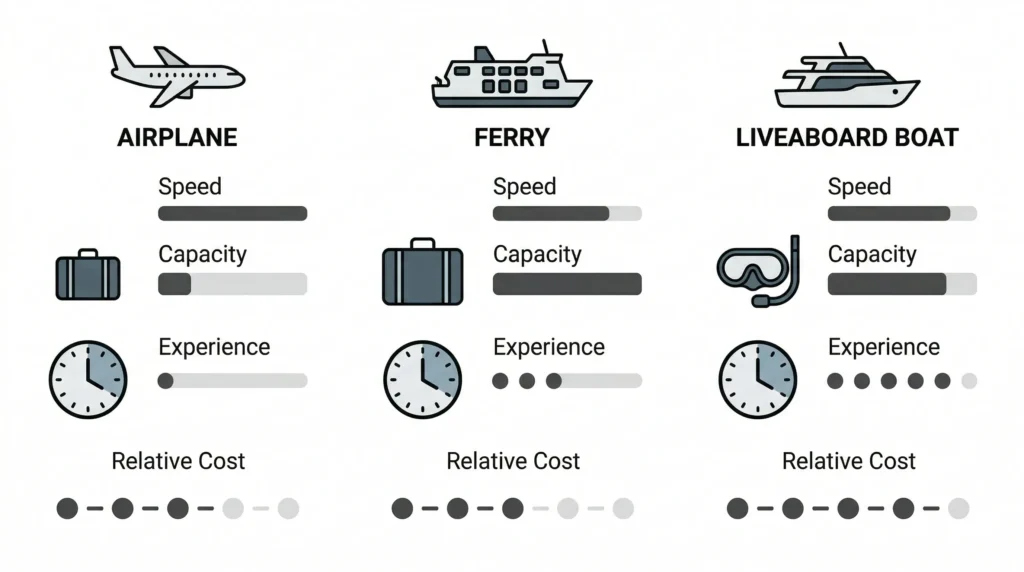
Travel Time Comparison
| Route | Door-to-Door Duration | Main Uncertainty Factor |
|---|---|---|
| By Plane (via Bali) | 5–7 hours | Connection timing at Bali |
| Liveaboard (Boat) | 4–10 days (journey = experience) | Itinerary length and weather |
| Overland & Ferry | 24–40+ hours | Sape ferry schedule; bus timing |
The plane is unambiguously the fastest option for reaching Labuan Bajo. The liveaboard reframes the question entirely — travel time becomes irrelevant when the boat is the destination. The overland route is always the slowest and, for most travellers, offers the least return on the time invested.
Cost Comparison Overview
The figures below are per-person estimates based on recent travel seasons. Indonesian transport pricing fluctuates with fuel costs, carrier competition, seasonal demand, and booking lead time. Treat these as directional ranges, not fixed quotes; verify all fares before travelling.
| Route | Estimated Cost Per Person (USD) | What Is Covered |
|---|---|---|
| By Plane (LOP–DPS–LBJ) | $60–$180 | Flights only; accommodation, park tours, and entry fees are separate |
| Liveaboard (3–5 nights) | $300–$900+ | Transport, onboard accommodation, all meals, park entry, guided activities |
| Overland & Ferry | $25–$60 | Ferry tickets and bus fares only; meals and any accommodation extra |
A note on the practical cost gap between flying and the liveaboard: when the total cost of flying to Labuan Bajo is combined with two to four nights of accommodation in town, daily boat tours into the park, park entry fees, and meals, the real-world expenditure often approaches the lower end of a quality liveaboard package. Travellers who plan to spend four or more nights in the Komodo area should run this comparison honestly before assuming the flight option is the cheaper choice.
Best Way to Get from Lombok to Komodo
The correct option depends on three variables: time available, budget ceiling, and the type of experience sought. The following decision summary applies to most traveller profiles.
| Traveller Profile | Recommended Option | Rationale |
|---|---|---|
| Limited time (under 10 days total) | Fly via Bali | Only option that allows a full day in the park within a short itinerary |
| Diver or serious snorkeller | Liveaboard | Access to full range of dive sites; onboard efficiency; timed park access |
| Backpacker, maximum budget constraint | Overland & ferry | Viable if schedule is flexible and physical demands are accepted |
| Family or mixed-ability group | Fly via Bali | Overland route is not suitable; liveaboard open-water crossing is variable |
| Wet season travel (Nov–Mar) | Fly via Bali | Sea conditions reduce liveaboard comfort; overland ferry schedules less reliable |
| Seeking complete Komodo immersion | Liveaboard | Sunrise at Padar, remote dive sites, and no Labuan Bajo town logistics |
One recommendation applies universally: do not attempt the overland and ferry route if you have a fixed departure flight from Labuan Bajo within 48 hours of expected arrival.
The Sape–Labuan Bajo ferry is the single most unreliable link in this chain, and a missed connection has downstream consequences that a flexible schedule can absorb but a fixed itinerary cannot.
For travellers who prioritise immersion over speed, liveaboard journeys consistently deliver the most complete Komodo experience. This komodo tour from lombok follows a direct multi-day route across the Flores Sea, allowing continuous access to remote islands, sunrise trekking at Padar, and guided exploration inside Komodo National Park without the need for repeated transfers.
Final Travel Tips Before Going
Book peak season travel well in advance. The dry season window of July through September represents the highest demand period for both flights to Labuan Bajo and liveaboard berths. As of recent travel seasons, Wings Air’s Bali–Labuan Bajo route sells out weeks ahead during peak months, and quality liveaboard boats are often fully booked two to four months prior to departure. Waiting until four weeks before travel in August is a reliable way to find neither available flights nor available boats at acceptable standards.
Understand the park entry system before you arrive. Komodo National Park introduced a visitor quota and updated fee structure in 2023, with regulations continuing to evolve into subsequent seasons. Access to specific islands — particularly Komodo Island’s dragon trekking trails — has been subject to daily visitor limits and booking requirements. Confirm the current access procedures with your boat operator or directly with park authorities before finalising plans. Do not assume the system operates the same way it did when you read a review from two years prior.
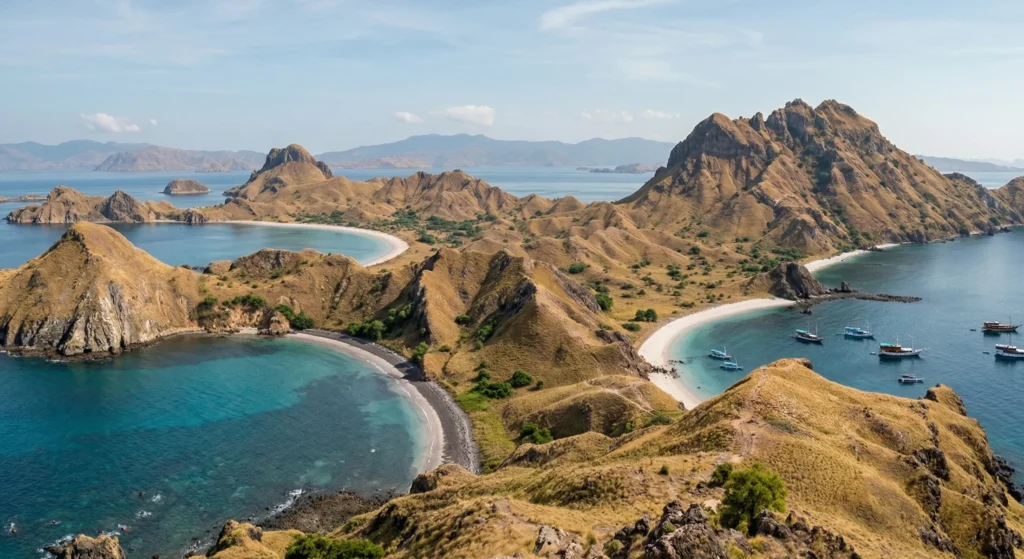
The Padar Island trek is more demanding than photographs suggest. The ridge trail to the three-bay viewpoint is short — roughly 1.5 kilometres to the summit — but steep, rocky, and typically done before sunrise. Travellers who arrive physically depleted from the overland route, or who have not slept properly on an overnight ferry, will find this trek noticeably harder. Liveaboard itineraries build recovery time and proper sleep into the schedule before this hike; day-trip travellers should prioritise rest the night before in Labuan Bajo.
Currency access inside the park is non-existent. ATMs are available in Labuan Bajo but have been known to run out of cash during high-traffic periods. Carry adequate Indonesian Rupiah withdrawn before leaving Lombok. Mobile data coverage is limited to negligible across most of the national park; download offline maps, accommodation confirmation details, and return flight information before departing the harbour.
Labuan Bajo has developed significantly as a tourism hub. As of recent travel seasons, the town offers a full range of accommodation from budget guesthouses to upmarket waterfront resorts, along with reliable restaurants, dive equipment rental, and organised tours. Airport transfers from Komodo Airport (LBJ) into town take approximately ten minutes; agree on a fixed fare with drivers at the arrival area or use a ride-hailing application to avoid variable pricing.
Weather awareness is not optional. The Flores Sea between November and March is subject to strong westerly winds and swells that make open-water crossings uncomfortable and, in severe cases, unsafe. This does not make wet-season travel impossible — plenty of travellers visit Komodo in November or February with good experiences — but it raises the risk profile of the liveaboard option and reduces predictability on the overland ferry route. The dry season is dry for a reason: this is unambiguously the better period to visit.
The journey from Lombok to Komodo is logistically manageable for any reasonably prepared traveller. What distinguishes the options is not difficulty but orientation: you can cover the distance efficiently and spend your energy inside the park, or you can let the crossing itself become part of what the trip means. The geography of eastern Indonesia rewards both approaches. The key is choosing the one that matches how you actually travel — not the one that sounds most adventurous in theory.
Travel Planning Resources
- To plan your departure window and avoid weather-related disruptions, read best time to visit Lombok before finalising your route to Komodo.
- If you are choosing between destinations, this comparison of Pink Beach Lombok vs Komodo explains which pink-sand beach experience best matches your travel style.
- For a deeper understanding of what awaits at the destination, explore this complete guide to Komodo Island, including wildlife, landscapes, and park regulations.
- To align sea conditions, visibility, and trekking comfort, consult best time to visit Komodo Island when scheduling your trip.