The best time to visit Lombok is during the dry season, which runs from May through October. During these months, you get consistently sunny skies, calm seas, excellent underwater visibility, and ideal conditions for exploring the Gili Islands, trekking Mount Rinjani, and crossing to Komodo National Park. That said, Lombok rewards travelers in nearly every month of the year — the key is knowing what you’re walking into.
In this guide, you’ll find a complete breakdown of Lombok’s weather patterns, a month-by-month planner, travel style recommendations, and honest advice on when to avoid certain activities. At PhinisiTrip, we specialize in marine and island experiences across eastern Indonesia, so this advice is grounded in real on-the-water knowledge and seasonal navigation patterns between Lombok and Komodo.
Lombok Weather Overview: Dry Season vs Rainy Season

Lombok sits just east of Bali in the Lesser Sunda Islands, but its climate behaves differently. The Wallace Line passes between the two islands, and while that’s primarily a biogeographical boundary, it also signals the start of a drier, more arid climate to the east. Lombok receives significantly less annual rainfall than Bali, and its rain shadow positioning means southern and central parts of the island stay drier for longer.
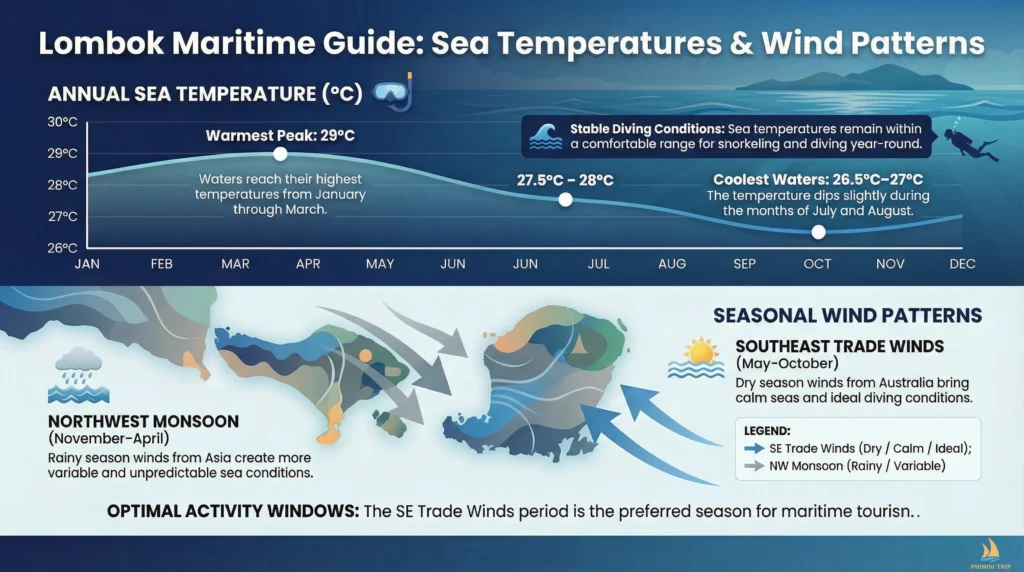
The island operates on a classic tropical pattern: a dry season driven by southeast trade winds, and a rainy season brought in by northwest monsoon moisture. Sea conditions shift accordingly, which matters enormously if boat crossings, snorkeling, or diving are part of your plans.
Dry Season vs Rainy Season at a Glance
| Factor | Dry Season (May – Oct) | Rainy Season (Nov – Apr) |
|---|---|---|
| Rainfall | Low to negligible | Moderate to heavy |
| Sea conditions | Calm, predictable | Variable, rougher crossings |
| Underwater visibility | 20–30+ metres | 10–20 metres |
| Crowds | High (Jul–Aug peak) | Low to moderate |
| Prices | Higher (peak months) | Lower, good deals available |
| Rinjani trekking | Open | Closed Nov–Mar |
| Surf quality | Good (south coast) | Excellent (peak season) |

Dry Season (May – October)
From May through October, Lombok shifts into its most visitor-friendly window. Daily sunshine averages 8–10 hours, humidity drops to a manageable level, and the southeast trade winds keep temperatures comfortable rather than stifling. Daytime temperatures hover between 28–32°C, cooling noticeably at higher altitudes near Rinjani.
Sea conditions across the Lombok Strait and toward the Gili Islands are calm and consistent. Underwater visibility in snorkeling and diving sites typically reaches 20 to 30 metres, sometimes more at cleaner sites. These are the conditions that make island hopping genuinely enjoyable rather than just tolerable.
July and August represent peak tourism months. European summer holidays and school breaks drive a significant surge in visitors, particularly to the Gili Islands. Accommodation books out fast, prices rise sharply, and the boat jetties get busy. If you want dry season conditions without the crowds, May, June, and September are the sweet spots.
October remains reliably dry for most of the month before transitioning to the shoulder period. It’s an underrated month that sees fewer visitors but retains excellent weather.
Rainy Season (November – April)
The wet season in Lombok is not what most people imagine. Rainfall typically arrives in short, intense afternoon or evening bursts rather than sustained grey drizzle. Mornings are often clear, and whole days can pass without significant rain, especially in November and December.
January and February see the heaviest and most unpredictable rainfall. Sea conditions become variable, and boat crossings to the Gili Islands or toward Sumbawa can be rougher. Underwater visibility decreases but rarely becomes unworkable for snorkeling.
The upside is real. Lombok’s interior turns intensely green, waterfall flow is at its peak, and accommodation rates drop substantially. Crowds at the Gili Islands thin to a fraction of peak season levels. For travelers who want a quieter, more local experience and can handle occasional disruptions to water activities, the shoulder months of November, March, and April offer genuine value.
Best Time to Visit Lombok
Lombok’s dry season is also the most reliable period for planning onward travel by sea, especially for routes heading east. Stable weather and calmer waters make this the ideal window to understand schedules, routes, and logistics explained in how to get from Lombok to Komodo.
Best Time for Gili Islands and Island Hopping
The Gili Islands — Gili Trawangan, Gili Meno, and Gili Air — are best visited from May through September. During these months, the short boat crossings from Bangsal or Teluk Nara are smooth, underwater visibility around the reef is excellent, and the beach conditions are at their most inviting.
Snorkeling visibility peaks between June and August, often exceeding 25 metres. The lack of significant swell means even nervous swimmers can enjoy calm-water snorkeling sites without discomfort.
Island hopping itineraries that extend south toward Kuta Lombok and the Sekotong peninsula also perform best in the dry season, when smaller speedboats can reach exposed outer islands without risk of uncomfortable swells.
Best Time for Diving in Lombok

Lombok’s dive sites vary significantly in character. The Gili Islands offer accessible reef diving year-round, but peak visibility runs from May through October. The deeper current-driven sites in the Lombok Strait demand dry-season timing, as calmer conditions allow boats to position safely and divers to manage the water column more predictably.
For those planning to combine Lombok with a Komodo liveaboard, the optimal overlap window is June through September. Komodo’s dive conditions peak between April and November, with Manta Point and the famous dive sites around Komodo and Rinca islands performing at their best in the core dry season months. A combined Lombok and Komodo diving trip during this window makes excellent logistical and experiential sense.
Current intensity in the Lombok Strait can be strong year-round, making some sites more suitable for advanced or experienced divers regardless of season.
Best Time for Surfing
Lombok’s south coast is home to some of Indonesia’s most consistent and respected surf breaks. Desert Point (Bangko Bangko) on the southwest peninsula is considered one of the finest left-handers in the world, while Gerupuk, Mawi, and Are Guling offer a range of breaks for different skill levels.
The prime surfing window runs from May through September, when the southeast swell combines with offshore winds to produce clean, powerful waves. July and August see the most powerful surf, which suits experienced surfers but can be too demanding for intermediates.
For intermediate-level surfers, June and September often provide the best balance of wave quality and manageable conditions. Gerupuk’s bay setup means learners can access calmer inner-bay waves while more experienced surfers head to the outer breaks.
The wet season produces surf as well, but onshore winds make it messier and less consistent. Desert Point can fire in the shoulder months, but access and consistency improve significantly in the core dry season.
Best Time for Mount Rinjani Trekking
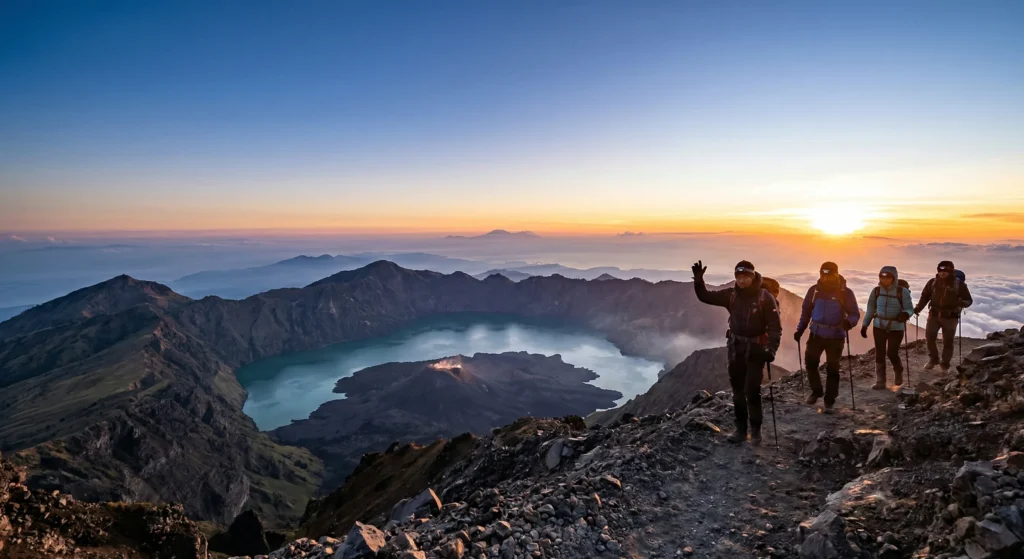
Mount Rinjani, at 3,726 metres, is Indonesia’s second-highest volcano and one of Southeast Asia’s most impressive trekking destinations. The summit route and the trails down to the crater lake are only safely accessible during the dry season.
The Rinjani trail system officially opens around April or May, depending on conditions assessed by the park authority, and closes by end of November at the latest. January through March see full closure due to rain, trail erosion risk, and dangerous summit conditions.
The best months for trekking are July, August, and September. Skies are clearest, summit visibility is reliable, and trail surfaces are at their most stable. June is also excellent and slightly quieter. May and October work for well-prepared trekkers but carry slightly more weather risk at higher elevations.
Sunrise from the Rinjani summit on a clear dry-season morning is one of those experiences that justifies any amount of planning.
Lombok Month-by-Month Guide
January
- Rain level: High
- Crowd level: Very low
- Sea: Variable to rough
- Prices: Low
January is the wettest month. Rinjani is closed. Sea crossings to the Gilis can be uncomfortable. Culturally interesting, budget-friendly, and uncrowded — worth considering only if weather flexibility is your priority. Best for: budget travel, photography of green landscapes.
February
- Rain level: High
- Crowd level: Very low
- Sea: Variable
- Prices: Low
- Similar to January
Short rainfall bursts, green hillsides, and excellent waterfall hiking near Senaru. Diving on the Gili reefs is still possible on better days. Best for: budget-conscious travelers, waterfall visits.
March
- Rain level: Moderate to high
- Crowd level: Low
- Sea: Improving
- Prices: Low
Rainfall begins to ease in the second half of March. A transitional month. Rinjani remains closed. The Gilis become more accessible. Best for: shoulder season bargains, early surfers.
April
- Rain level: Moderate
- Crowd level: Low to moderate
- Sea: Generally calm
- Prices: Low to moderate
April marks the start of the transition. Rainfall drops significantly, seas calm down, and Rinjani begins reopening for the season. Dive visibility improves week by week. Best for: early dry-season divers, budget travelers who want good weather without peak prices.
May
- Rain level: Low
- Crowd level: Moderate
- Sea: Calm
- Prices: Moderate
May delivers excellent conditions with manageable crowds. One of the most underrated months to visit. Rinjani is open, seas are calm, and the island hasn’t yet filled up with peak-season visitors. Best for: trekking, diving, island hopping.
June
- Rain level: Very low
- Crowd level: Moderate to high
- Sea: Calm
- Prices: Moderate to high
June is consistently excellent. Visibility underwater is building toward its peak, surf on the south coast is firing, and Rinjani offers clear summit mornings. Best for: surfers, divers, trekkers, and those combining Lombok with a Komodo liveaboard.
July
- Rain level: Negligible
- Crowd level: Peak
- Sea: Calm
- Prices: High
The most popular month. Everything is working — weather, sea, surf, diving — but accommodation is expensive and the Gilis are noticeably busy. Book well in advance. Best for: all activities, families, anyone who needs school holiday timing.
August
- Rain level: Negligible
- Crowd level: Peak
- Sea: Calm
- Prices: High
Identical to July in weather terms. Indonesian national holiday period (Independence Day, August 17) adds a domestic tourism surge mid-month. Book the best guesthouses months ahead. Best for: all activities; accept the crowds or plan around them.
September
- Rain level: Very low
- Crowd level: Moderate
- Sea: Calm
- Prices: Moderate
September is arguably the best all-round month. Peak crowds have thinned, prices ease, conditions remain excellent, and there’s a relaxed post-summer atmosphere. Rinjani is still open. Best for: almost everything — diving, trekking, island hopping, surfing.
October
- Rain level: Low to moderate
- Crowd level: Low to moderate
- Sea: Generally calm
- Prices: Moderate to low
The transition back toward wet season begins, but October is still largely dry. The first rains may arrive in the second half, and sea conditions can become less predictable. Best for: budget travel with good odds of fine weather, late-season diving.
November
- Rain level: Moderate to high
- Crowd level: Low
- Sea: Variable
- Prices: Low
Wet season begins in earnest. Rinjani closes for the year. Rainfall increases but mornings often stay clear. Best for: budget travelers, those interested in Lombok’s quieter, greener side.
December
- Rain level: High
- Crowd level: Low, with Christmas/New Year spike
- Sea: Variable
- Prices: Low except Christmas week
December is wet but there’s a brief surge of visitors around Christmas and New Year. The Gilis have a festive atmosphere. The Christmas week exception aside, it’s a low-cost, low-crowd month.
Best for: budget travel outside the holiday spike, rain-tolerant adventurers.
High Season vs Low Season in Lombok
Lombok’s tourism calendar is shaped by two main forces: European summer holidays and Indonesian school and national holiday periods. When both overlap — as they do in July and August — the island experiences its most concentrated visitor numbers.
The Gili Islands bear the brunt of peak-season pressure. Accommodation on Gili Trawangan books out entirely during the peak window, and prices can triple compared to low-season rates.
| Period | Months | Crowd Level | Price Level |
|---|---|---|---|
| Peak season | July – August | Very high | High |
| Shoulder season | May – June, September – October | Moderate | Moderate |
| Low season | November – April | Low | Low to moderate |
For travelers with flexible schedules, the shoulder months offer the most value. You get reliable weather, uncrowded dive sites, and accommodation at reasonable rates — without sacrificing any meaningful experience quality.
Indonesian domestic tourism adds spikes around the Eid al-Fitr period (dates vary annually by lunar calendar), the Christmas and New Year window, and national school holidays in late June and early July. These are worth factoring in when booking.
Is Lombok Better Than Bali for Weather?
Lombok receives noticeably less annual rainfall than Bali. Bali’s mountainous interior acts as a rain trap, particularly on the north and west coasts, while Lombok’s positioning further east gives it a longer effective dry season and less rainfall overall during the transitional months.
Lombok’s south coast and central plains stay drier into November in most years, and recover to usable conditions earlier in April than many comparable Bali destinations. The humidity is also somewhat lower during the core dry season, making outdoor activities more comfortable.
Beyond weather, Lombok offers a less developed, less congested alternative to Bali’s increasingly busy coastal corridors. The southern beaches around Kuta Lombok and the Mandalika area retain a scale and character that Bali’s south coast has largely lost. This isn’t a knock on Bali — it’s useful context for travelers who find Bali’s high season overwhelming.
When Not to Visit Lombok
Transparency matters here. There are genuine reasons to reconsider certain trips at certain times.
January and February bring the island’s heaviest and most sustained rainfall. Sea crossings to the Gili Islands and beyond become uncomfortable and occasionally unsafe for small boats. If your trip revolves around snorkeling, diving, or island hopping, these months carry real risk of disruption. Rinjani is closed. Accommodation quality can feel more limited when many guesthouses reduce staffing.
The Rinjani park typically closes from late November through March, sometimes extending into April if damage assessment takes longer. Attempting to trek outside the official season is not just uncomfortable — it carries genuine safety risk, and local guides will often decline to take groups up in closed conditions for good reason.
Heavy rainfall in January and February can also affect road access to southern Lombok’s beaches, and ferry services across the Lombok Strait to Sumbawa can be cancelled during rough weather periods.
None of this makes Lombok impossible in these months. It does mean you should plan with contingencies and not build an itinerary that depends entirely on clear skies and calm seas.
Best Time to Combine Lombok with Komodo
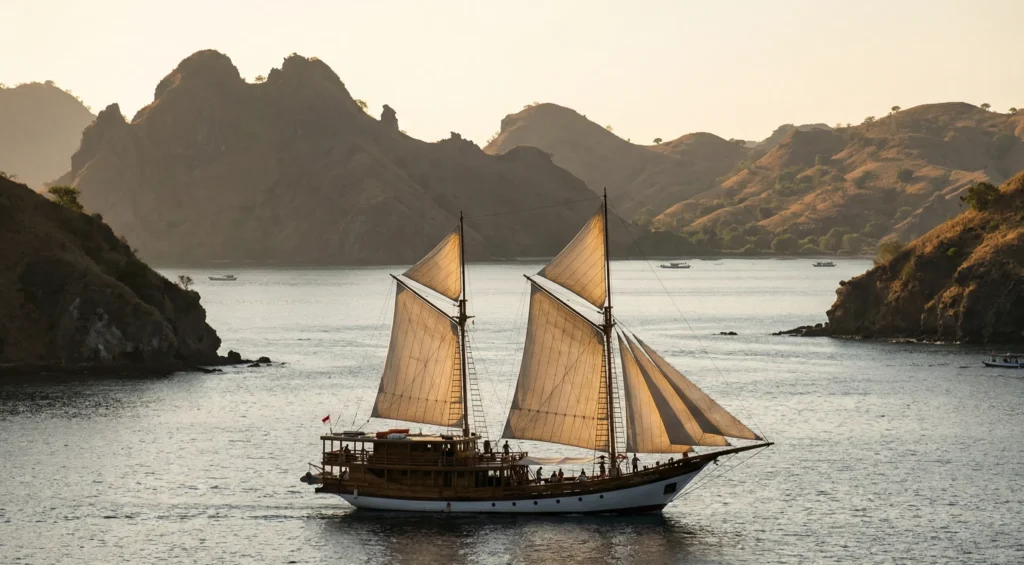
Lombok and Komodo National Park share the same optimal travel window: May through October. This alignment makes a combined trip not just logical but genuinely well-designed. Many travelers extend their itinerary with a Komodo trip from Lombok during this period, when sea crossings are stable and marine visibility is at its peak.
Both destinations sit within a larger eastern Indonesian marine corridor, and the dry season trade winds create stable sea conditions across the whole region simultaneously. Diving in Komodo reaches peak visibility and marine activity between April and November, with July, August, and September considered the prime months for manta ray encounters at Manta Point and for the rich biomass that makes sites like Crystal Rock and Batu Bolong so celebrated. If pink sand beaches are part of your route planning, comparing Pink Beach Lombok vs Komodo helps clarify seasonal access, sea conditions, and overall experience differences.
A 10 to 14-day itinerary that begins in Lombok — combining Gili Islands snorkeling, a Rinjani trek, and south coast surfing — before transitioning to a Komodo liveaboard is one of the most complete adventure travel experiences available in Southeast Asia. The liveaboard journey from Lombok to Labuan Bajo passes through some spectacular and rarely visited intermediate islands, and the marine diversity encountered along the route rivals anything in the Indo-Pacific.
If you’re considering this combination, June and September offer the best balance of excellent conditions, manageable crowds, and available liveaboard berths. July and August are excellent for conditions but require booking months in advance on quality vessels.
Final Verdict: When Should You Visit Lombok?
Budget traveler: March, April, or October. You’ll find good deals, weather is transitional but largely workable, and the island feels genuinely local rather than tourist-saturated.
Honeymoon couple: June or September. Romantic without being overcrowded. Sunsets over the Gilis are stunning, accommodation has more availability than peak months, and the atmosphere is relaxed.
Diver: June through September for optimal visibility and the best window for combining with a Komodo liveaboard trip. Komodo’s sites reward the extra planning effort enormously.
Adventure traveler: July or August for Rinjani summit conditions at their clearest, or September for the same quality with fewer other trekkers on the trails.
Photographer: May for lush green hillsides still present from the wet season alongside the improving dry-season light. September for clean skies, dramatic Rinjani views, and coastal golden hour conditions.
Family trip: July, accepting the crowds as part of the deal in exchange for reliable weather and maximum activity availability. September is worth considering if school schedules allow — the payoff in atmosphere and pricing is significant.
FAQ
Is December a good time to visit Lombok?
December is a wet month, so it depends on your expectations. Morning skies are often clear, and the Gili Islands maintain a festive atmosphere around Christmas and New Year. Sea conditions are variable, making snorkeling and diving less reliable. Prices are low outside the holiday spike. If you’re flexible and not solely focused on water activities, December can work — but it’s not a recommended first-choice month for marine-focused itineraries.
What is the hottest month in Lombok?
October and November tend to produce the highest perceived heat as humidity rises at the end of the dry season. Daily highs reach 33–35°C in coastal areas. January and February are also very warm and humid. The most comfortable temperature combination of warmth and lower humidity occurs in July and August, when southeast trade winds provide natural cooling.
Is July too crowded in Lombok?
The Gili Islands in July are genuinely busy, and Gili Trawangan in particular takes on a busy resort-town character. If you’re sensitive to crowds, July requires strategic planning — choosing Gili Meno or Gili Air over Trawangan, booking accommodation well in advance, and front-loading activities before peak beach hours. Outside the Gilis, Lombok’s south coast and interior remain relatively peaceful even in July.
Can you visit the Gili Islands during rainy season?
Yes, but with adjusted expectations. Boat crossings become less predictable, snorkeling visibility drops, and there will be days when weather disrupts plans. That said, the Gili Islands never fully close, accommodation rates drop substantially, and there’s a quiet, unhurried quality to the islands in the low season that many travelers actually prefer. The Gilis in February feel entirely different from the Gilis in August — slower, more local, and cheaper.
When is the sea calmest in Lombok?
The calmest consistent sea conditions occur from June through September, when southeast trade winds stabilize without producing significant swell. May and October are nearly as calm. The Lombok Strait sees its roughest conditions from December through February, when northwest monsoon winds push in from the Indian Ocean.
Is Lombok better than Bali weather-wise?
For most of the year, yes. Lombok receives less annual rainfall, has a longer effective dry season, and sees less weather disruption during the transitional months. The south coast and central plains areas are particularly dry. Bali’s popularity also means its weather patterns are more heavily impacted by infrastructure heat islands and deforestation in some coastal zones. For travelers who want reliable sunshine and calm seas for the longest possible window, Lombok offers a genuine advantage over most Bali resort areas
.